Clearness Committee Prep
A gentle guide for the Friend seeking clearness, and for the Friends who sit with them.
What it is
Clearness Committee Prep is a small web guide for a very old Quaker practice. A Friend facing an important decision, a change in life, or a leading they want to test may ask the Meeting for a clearness committee. The committee does not give advice. Its members ask careful, open-ended questions to help the Friend see whether there is enough clarity to move forward.
The guide has two paths. The Friend can prepare the short written account that the committee reads ahead of time. Committee members can read about their role, the shape of the first meeting, and sample questions to spark their own.
Note
The sample questions are my own wording. Your Meeting's own practice comes first.
- Made by
- Bill Warters with assistance from Claude AI
- Format
- One web page that runs in any modern browser, on a phone, tablet or computer. It follows your device's light or dark setting.
- Privacy
- Nothing is saved or sent anywhere. What you type stays on the screen and disappears when you close the page.
- Grounded in
- Guidelines for a Clearness Committee, in Faith and Practice of Philadelphia Yearly Meeting
- Lives at
- tools.leym.org/clearness, in the Lake Erie Yearly Meeting tools collection
How it works
There are three sections:
- Overview. What a clearness committee is for, what usually happens at a first meeting (worship, deep listening, open-ended questions, time to respond, and next steps), and how confidentiality and reporting work.
- I'm the Friend. A set of gentle prompts builds your short paper as you type: the issue or leading, relevant background, steps you might take, who may be affected, and optional notes on where you feel unclear and which Friends you might suggest. You can copy the paper or print it, and printing shows only the paper.
- I'm on the committee. Your role (ask questions, not advice, and set aside your own stories), a picker for sample questions in six groups, a short table on how advice sneaks into questions, and what to do afterward.
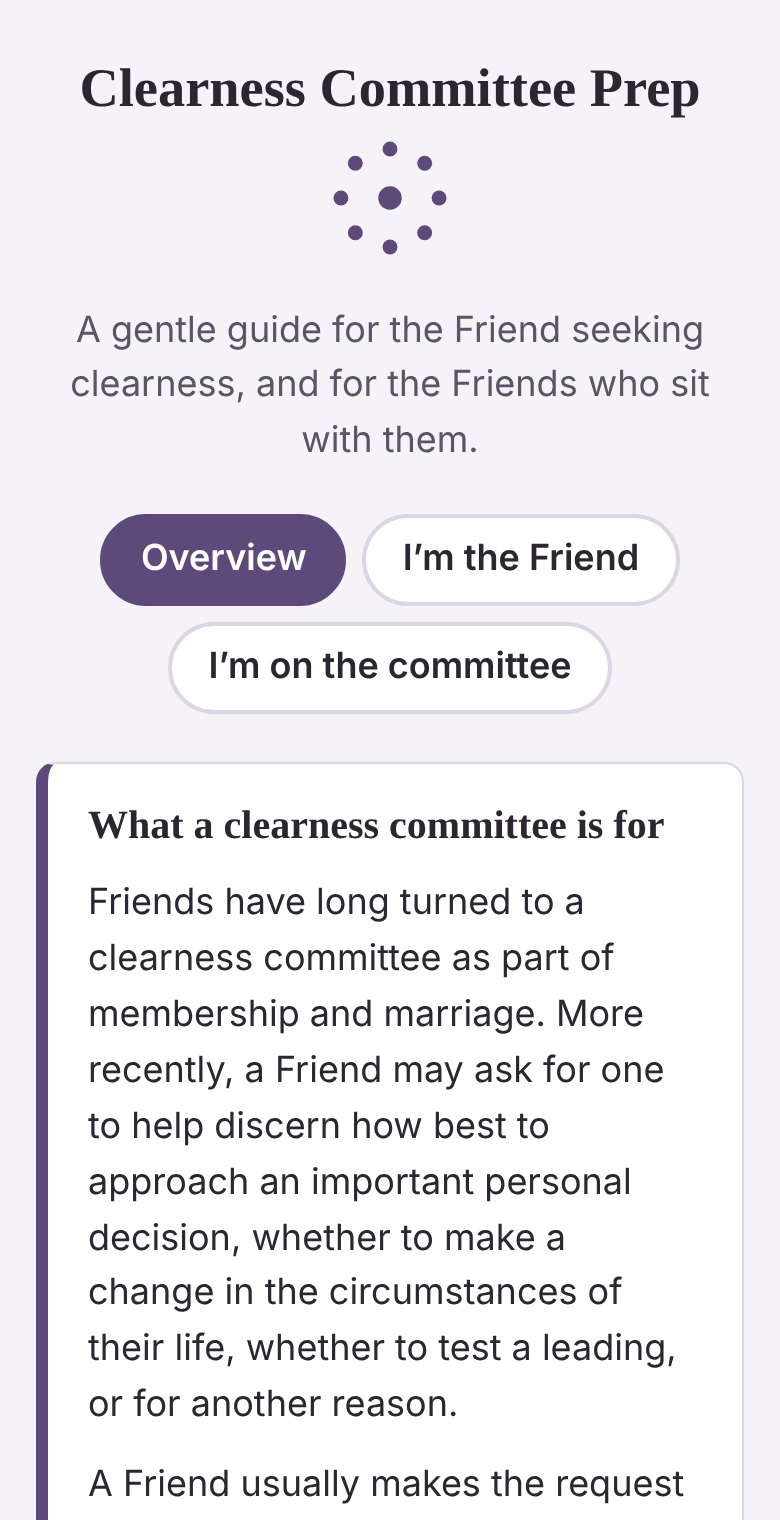
The overview, in the Evening Light colors.
Sample questions
The guidelines do not include example questions, so the sample questions are written for this guide and labeled that way. They fall in six groups: understanding the concern, testing the leading, who is affected, next steps, and a group for when a leading may need the Meeting's support. Choose a group and the page offers one question at a time, which you can copy, or you can open the whole list.
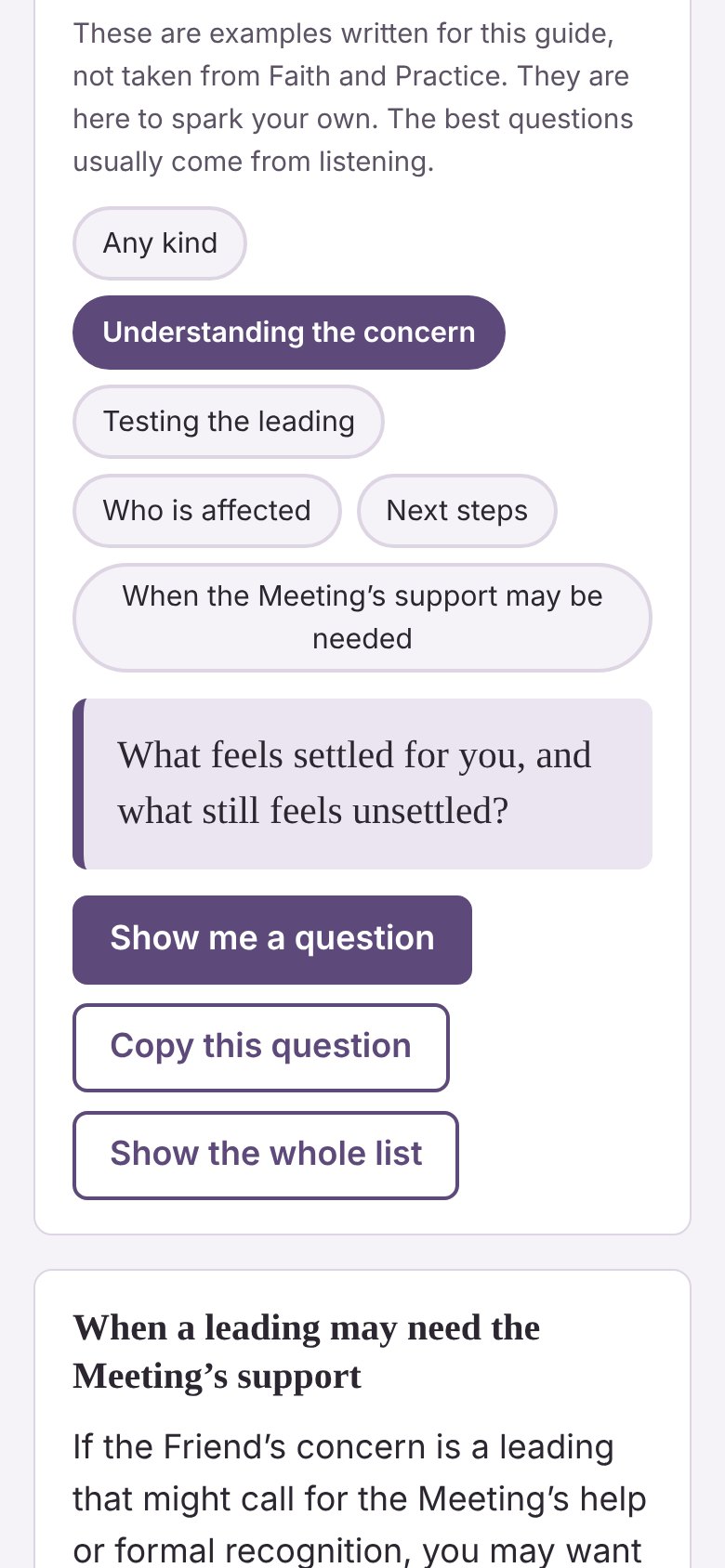
The question picker: choose a group, then ask for a question.
Seeing it in dark mode
The page follows your device's setting. On a phone or computer set to dark, it appears with light text on a dark background.
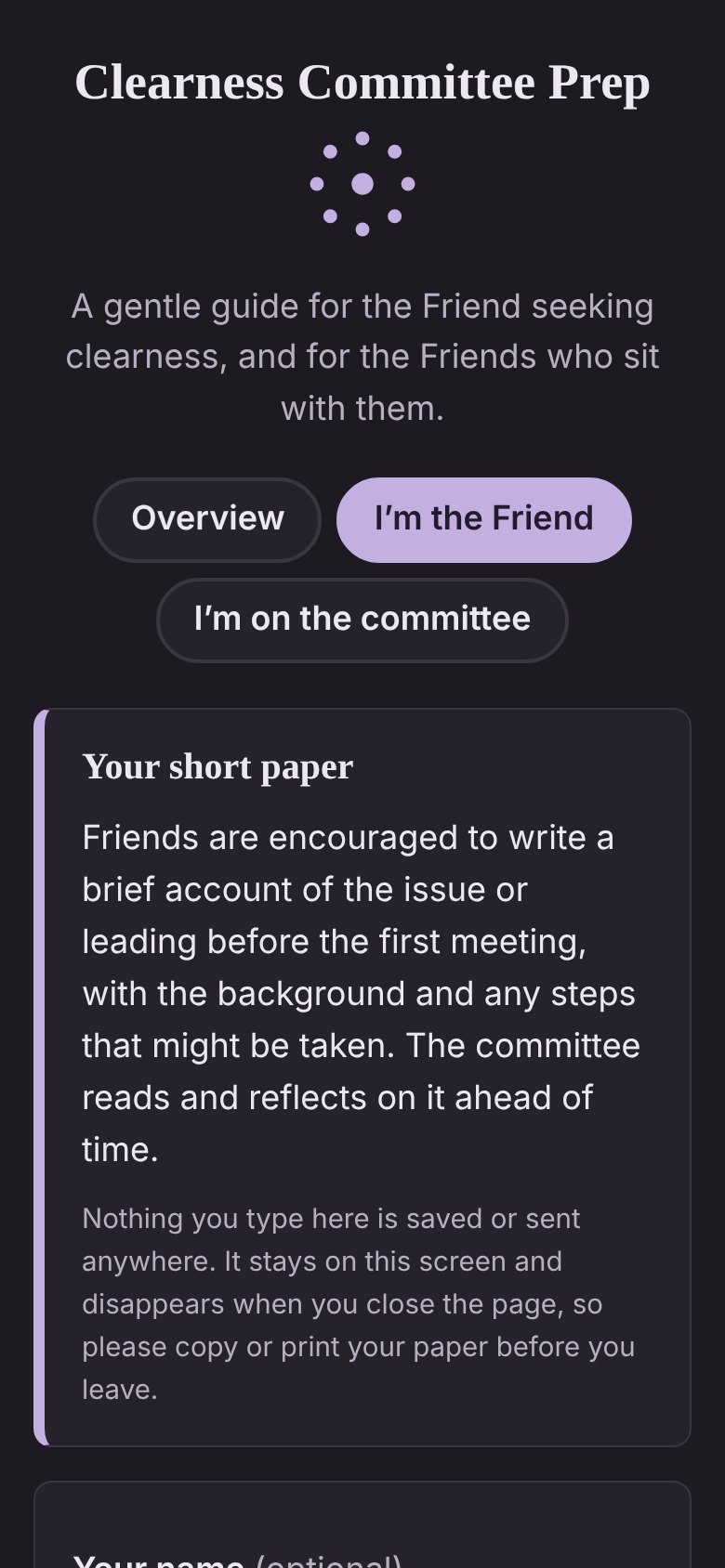
The Friend's section in dark mode.
Testimonies in the making
- Simplicity: one page, a few plain prompts, and nothing to install or sign in to.
- Integrity: the guide stays close to the written guidelines, says plainly which parts are new, and credits its sources.
- Community: the practice itself asks a few Friends to sit with one Friend, listen, and ask good questions together.
Who it is for
Friends asking their Meeting for a clearness committee, Friends asked to serve on one, and ministry and care committees that help arrange them. It is a thinking aid. It is not a substitute for your Meeting's own process or ministry and care. If a situation involves someone's safety, please turn to your Meeting's ministry and nurture/care committee, or to appropriate professional help.
Where it came from
The overview and the roles are summarized from the Guidelines for a Clearness Committee in Faith and Practice of Philadelphia Yearly Meeting. Illinois Yearly Meeting's Faith and Practice offers a fuller set of questions for leadings that may need the Meeting's support, and the guide points readers there. The paper prompts, sample questions and examples are original to this guide.